
Hidden Histories & Material Memory
History leaves evidence everywhere—if we learn where to look.
Sara Madden’s nonfiction explores the people, labor, objects, and systems that traditional histories often leave at the edges. Across Hidden Histories of Women, Hidden Histories of War, and Material Memory, she looks beyond the familiar record to ask different questions: Who was written out? Who carried what remained? What can an object remember when the archive falls silent? Drawing from history, anthropology, archaeology, material culture, archival research, and humanitarian experience, these books recover the traces left in names, bodies, tools, textiles, graves, letters, kitchens, stones, vessels, water, and memory itself.
They are not simply books about what happened.
They are books about what survived, who carried it, and what we are responsible for remembering now.
HIDDEN HISTORIES OF WOMEN—Who was written out?
HIDDEN HISTORIES OF WAR — Who carried what remained?
MATERIAL MEMORY—What remembers when people cannot?
Hidden Histories of Women
Who was written out—and what changes when we put her back? History did not simply forget women. It blamed them. Misnamed them. Credited someone else. Reduced their labor to custom, their knowledge to superstition, their art to anonymous craft, and their survival to silence.
But women kept leaving evidence. In manuscripts and textiles. Recipes and rituals. Letters and songs. Pottery and printing presses. Bodies, objects, archives, and memory. Hidden Histories of Women traces those surviving marks.
Drawing from history, anthropology, archaeology, material culture, feminist scholarship, and archival research, Sara Madden examines not only the women whose stories were obscured, but the systems that decided whose knowledge counted in the first place.
These books are not simply collections of forgotten women.
They are investigations into how forgetting happens—and how memory fights back.

The Blame: A Hidden History of Heresy, Genius, and the Violence of Erasure
The crime was thinking. The sentence was erasure.
Eve reached for knowledge. Pandora opened the vessel. Helen launched a thousand ships. Again and again, Western culture learned the same lesson:
When something goes wrong, find the woman.
The Blame follows that pattern from ancient myth and religious doctrine through witch persecutions, stolen intellectual credit, scientific exclusion, reproductive control, economic invisibility, digital algorithms, and modern systems of historical memory. At its center are the women whose knowledge made them dangerous.
Hypatia.
Healers and midwives.
Artists whose names became Anonymous.
Scientists whose discoveries migrated into someone else's bibliography.
Writers, theologians, thinkers, rebels, and ordinary women whose work survived even when their names did not.
But The Blame is not merely a catalog of injustice. It is an investigation into how erasure works. How myth becomes doctrine. How doctrine becomes law. How law becomes custom. How custom becomes an archive that appears neutral even after the people who built its exclusions are gone. And how women resisted every step of the way—writing in code, preserving forbidden knowledge, documenting discoveries, building networks of memory, and leaving fingerprints history could never completely remove.
The book explicitly describes these recurring instances not as isolated discrimination, but as a system operating across cultures, technologies, and centuries.
They tried to erase the names. The evidence remained.
EXPLORE: Women & Myth • Heresy • Witch Persecution • Intellectual Credit • Reproductive Control • Science • Religion • Art • Digital Erasure • Historical Memory

Women & Culture: The Americas and Beyond-Hidden Narratives of Power, Preservation, and Reclamation
They took their voices. They could not take their roots.
Before culture could be written into textbooks, it had to be carried. Someone remembered the seed.
Someone taught the song. Someone ground the corn. Someone wove the cloth. Someone tended the medicine. Someone taught the child where she belonged.
Across civilizations, much of that work was done by women. Women & Culture explores women not as supporting figures in civilization, but as its cultural architects—the healers, farmers, weavers, storytellers, ceremony keepers, traders, knowledge holders, artists, mothers, and political actors who transmitted culture from one generation to the next. Its focus stretches across the Americas, with particular attention to Indigenous and African-descended women whose cultural labor survived colonization, enslavement, forced child removal, boarding schools, language suppression, sterilization, and other deliberate attempts at cultural destruction.
But this is not a story of disappearance. It is a story of survival. The manuscript insists on holding two truths at once: colonization destroyed irreplaceable knowledge, and women's resistance preserved enough for descendants to rebuild. It deliberately refuses both total-destruction narratives and overly triumphant recovery narratives. The book follows Seven Threads: Origin. Labor. Ceremony. Silence. Resistance. Reclamation. Return. They trace the movement of culture through loss and survival—what began, what women carried, what was destroyed, what resisted destruction, what is being recovered, and what can finally return.
The historical argument beneath all seven is simple and radical: Where women were erased, culture faltered. Where women were remembered, life endured.
EXPLORE: Indigenous Women • Cultural Survival • Material Culture • Traditional Ecological Knowledge • Foodways • Textiles • Ceremony • Colonization • Language • Reclamation • The Americas
.jpg)
Echoes in Print: Black Women and the Cultural Revolution of the Harlem Renaissance
They were expected to be silent. Then the keys began to speak.
The Harlem Renaissance is remembered for words.
Poetry. Novels. Jazz. Art. Performance. But before those words could enter the historical record, someone had to type them. Print them. Copy them.
File them. Photograph them. Record them. Distribute them. Preserve them.
Echoes in Print tells the story of Black women who recognized something profound about the modern world: If you control the tools of documentation, you have a better chance of controlling how you are remembered. From typewriters, mimeographs, cameras, phonographs, and printing presses to radio, publishing networks, archival systems, and eventually digital platforms, Black women transformed technologies not designed for their liberation into tools of self-definition.
Among them are writers, editors, artists, performers, publishers, organizers, and cultural architects, including Zora Neale Hurston, Nella Larsen, Georgia Douglas Johnson, Jessie Redmon Fauset, Alice Dunbar-Nelson, Augusta Savage, Josephine Baker, Amy Jacques Garvey, Mary Church Terrell, and many others. But the book also looks behind the celebrated names. At the typists.
The filing. The carbon copies. The business correspondence. The mimeographed newsletters.
The shared machines. The infrastructure without which cultural movements cannot become archives.
The book makes that argument explicitly: Black women used typewriters, cameras, presses, recording technologies, radio and filing systems as weapons against erasure—building what it calls the “machinery of memory.” And the story does not stop in Harlem. It follows that lineage forward—from paper to pixel, typewriters to keyboards, mimeographs to independent digital platforms—showing how contemporary Black women continue to bypass gatekeepers, build audiences, and document themselves on their own terms.
They didn't just write to be heard. They wrote to be remembered.
EXPLORE: Harlem Renaissance • Black Women Writers • Typewriters • Print Culture • Technology • Journalism • Publishing • Music • Archives • Self-Representation • Digital Activism
Hidden Histories of War
War does not end when the fighting stops. Someone gathers the dead. Someoen binds the wounds. Someone makes the meal. Someone writes down the name. Someone carries the painting out of the burning building. Someone sings, sketches, stiches, records, comforts, searches, buries, remembers. Eventually someone has to live with what they saw.
Hidden Histories of War is a human history of conflict told through the people traditional military narratives too often leave at the edges. Rather than concentrating on generals, campaigns, weapons, and victories, Sara Madden follows the labor that makes survival, dignifty, remembrance, and recovery possible.
These books cross centuries, cultures, and conflicts to recover the caretakers, healers, cooks, artists, clerks, nurses, gravediggers, humanitarian workers, creators, families, and witnesses whose stories receive the same attention as the battles around them.
Because war has always required more than fighters.
It has always required people willing to carry what war leaves behind.
Sara Madden approaches military history from the edsges of the battlefield. Her work draws on anthropology, archaeology, material culture, humanitarian history, and firsthand volunteer experience with families, veterans, International Humanitarian Law, and family-restoration work. That perspective shapes the questions behind the series: Who cared? Who carried? Who remembered? Who survived the work of helping others survive? Hidden Histories of War is not an attempt to make war heroic. It is an attempt to make its invisible human labor visible.

Known Unto Us: The Hidden History of War's Caretakers
Someone always stays behind to care for the dead.
Who remembers them? We remember the soldier.
We rarely remember the person who carried his body. Across centuries of war, gravediggers, stretcher-bearers, mortuary workers, nurses, chaplains, clerks, forensic specialists, civilians, and fellow soldiers have performed one of humanity's oldest and most difficult obligations: bringing the dead home.
Known Unto Us follows the hidden history of war's caretakers from ancient burial customs and battlefield truces through the American Civil War, two World Wars, Korea, Vietnam, Iraq, Afghanistan, and modern forensic recovery. It asks not only how societies care for those killed in war, but what that work costs the living. Who washes the body?
Who identifies the remains? Who records the name? Who digs the grave? Who tells a family their loved one has been found? And who carries the memory when everyone else has gone home?
Blending historical research, anthropology, humanitarian law, material evidence, testimony, and personal witness, Known Unto Us restores the caretakers of war to the history they helped make.
The dead deserve to be remembered. So do the people who remember them.
EXPLORE: Deathcare • Graves Registration • Burial & Ritual • Identification • Moral Injury • Humanitarian Law • Memory • Anthropology
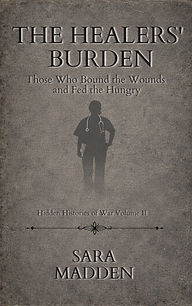
The Healers' Burden: Those Who Bound the Wounds and Fed the Hungry
Their hands did not take life. They held it.
Every army has depended upon people whose job was not to kill. Someone stopped the bleeding.
Someone carried the stretcher. Someone boiled the instruments. Someone stirred the soup. Someone handed a terrified nineteen-year-old a cup of broth and reminded him, for a moment, of home.
The Healers' Burden recovers the intertwined histories of battlefield medicine and military sustenance—the healers and feeders whose labor made survival possible while combat received the glory. From ancient herbs, battlefield kitchens, Indigenous medical knowledge, and Hospitaller care to Civil War nurses, trench medics, Donut Lassies, hospital ships, combat medicine, MREs, humanitarian kitchens, psychological trauma, and modern relief work, this volume asks a deceptively simple question: How do we keep human beings alive when everything around them conspires toward death?
Medicine and food may appear to be different histories. They aren't. The medic and the cook both serve the body. Both work against destruction. Both have historically depended upon labor performed disproportionately by women, enslaved people, colonized people, the poor, and others whose contributions were routinely minimized or erased.
The Healers' Burden is their history.
Because survival has always required more than medicine. Sometimes it requires a meal, a hand, and someone who refuses to leave.
EXPLORE: Battlefield Medicine • Food & Survival • Nurses • Medics • Military Cooks • Indigenous Knowledge • Humanitarian Care • Trauma • Invisible Labor

Carry the Light: Art, Literature, and the Humanities of War
War destroys. Human beings create anyway.
A poem written in a trench. A shell casing transformed into art. A diary hidden beneath a floorboard. A violin carried through a bombed city.
Embroidery stitched in captivity. A child's drawing made in a refugee camp. A painting saved from looting. A story told because someone had to remember.
Carry Forth the Light explores the astonishing persistence of creativity in places built for destruction. Across ancient memory-making, battlefield craft, trench poetry, underground newspapers, POW art, stolen cultural heritage, resistance writing, children's art, war literature, museums, restitution, peacebuilding, and digital remembrance, Sara Madden follows the artists, writers, musicians, makers, storytellers, and cultural guardians who continued to create when creation itself could become an act of resistance.
The book begins from a fundamental human impulse: I was here. I lived. I remembered. I hoped.
Its argument is not that art somehow makes war beautiful. It is that creativity helps people remain human inside systems designed to strip humanity away. The book explicitly frames art as survival and memory—something humans continued to carry through war in carved objects, scraps of poetry, music, embroidery, books, photographs and stories. It also extends that argument into children's creativity, where art can become a safer language than speech and a way of reclaiming the self after trauma.
Weapons tell us how wars were fought. Art tells us what people refused to let war destroy.
EXPLORE: Art & War • Literature • Trench Art • Cultural Heritage • Resistance • Children's Creativity • Museums • Restitution • Memory • Peacebuilding
Hidden Histories of Material Memory
What remembers when people cannot? A stone in a pocket. A bowl shaped by a grandfather's hands. Water carried from one place to another. Ordinary things rarely enter history books as protangonists. But objects live beside us. They absorb touch, labor, ritual, grief, habit, migration, violence, love, and care. Sometimes they survive the people who made them. Sometimes they disappear completely, leaving only an impression in the soil or a gesture remembered by the body.
Material Memory is a narrative nonfiction series about humanity's relationship with the things we hold, make, carry, tend, lose, and return. Drawing from archaeology, anthropology, material culture, environmental humanities, personal witness, and culture practice, Sara Madden follows objects not simply as artifacts but as participants in human life.
These books ask: What did our hands know before we hand words? What does an object carry after its maker is gone? When does carrying become responsibility? And when is the most meaningful thing we can do finally let go?

Collecting Stones: A Hidden History of Humanity
What We Carried When Words Failed
The stones remember what we forgot.
Long before human beings wrote history, our hands were already making it. We struck stone to make tools. Ringed fires with it. Ground food against it.
Built roads, graves, thresholds, monuments, borders, and homes. Left stones where someone died. Carried them away from places we could not otherwise bear to leave.
Collecting Stones follows stone across the human story—not simply as material, but as tool, teacher, marker, witness, weapon, memorial, and companion.
The book moves through five stages: Survival. Memory. Power. Witness. Release. Stone begins as something that keeps the body alive. It becomes something that marks where people lived and died. It builds empire and resistance. It becomes the small object carried in a pocket because grief needs weight. And eventually, it asks to be returned.
The book's arc is beautifully clear: stone moves from survival to memory, power, witness, and finally release, where an open palm is understood not as empty but as a different form of relationship.
At the center is one deceptively simple idea: We have always reached for matter when language fails us. Sara's own stone from Dachau becomes part of that inquiry—not as a souvenir, but as witness, accompanied by questions of permission, responsibility, and how stories of places of suffering should be carried forward.
EXPLORE: Archaeology • Stone Tools • Memory • Burial • Landscape • Empire • Protest • Memorials • Material Culture • Consent • Grief • Return

The Vessel: A Hidden History of Tended Things
What We Made When We Needed to Hold
Before we built monuments, we made something to carry supper home.
A cupped hand. A hollow gourd. A woven basket.
A clay pot. A lamp beside the bed. A wooden bowl made by someone whose hands are now gone. Vessels are everywhere in human history—and almost invisible within it. They carried water and grain. Held medicine and offerings. Cooked meals.
Stored surplus. Cradled bodies. Lit rooms. Crossed generations.
Yet because so much vessel-making was domestic, repetitive, practical, and frequently women's work, the makers themselves were rarely treated as artists worthy of historical attention. The Vessel begins there: with the work that disappeared into use.
The book asks what happens when humans move from simply holding to making something that can hold for us. From the anatomy of the cupped hand and humanity's earliest found containers to basketry, pottery, storage, fire, inheritance, craft knowledge, disposability, and the modern loss of hand-making traditions, The Vessel traces containment as one of civilization's most fundamental technologies. But vessels hold more than contents. They hold labor. Time. Technique.
Relationship.
The book's opening with Sara's grandfather's wooden bowls captures the idea perfectly: the bowl is not the maker, yet his choices, patience, hours, and touch remain materially present after him.
And that becomes the book's deeper claim:
Sometimes what we inherit isn't an object. It's a relationship made solid.
The book also asks a very modern question: what disappears when biodegradable, repairable, locally made vessels are replaced by disposable things designed to outlive both their contents and their users?
EXPLORE: Craft • Pottery • Basketry • Archaeology • Domestic Labor • Food Storage • Fire • Women's Work • Embodied Knowledge • Sustainability • Inheritance • Making

Collecting Water: A Hidden History of Survival
What We Carried When Stone Could Not Follow
Stone remembers by staying. Water remembers by moving.
Water cannot be kept the way stone can. It slips throughfingers. Evaporates. Floods. Freezes. Returns. And yet human life has always depended upon learning how to find it, carry it, protect it, ritualize it, control it, mourn through it, and eventually release it.
Collecting Water follows humanity's relationship with water from the first drink taken in cupped hands through migration routes, sacred springs, purification rituals, wells, dams, borders, drought, tears, memorials, climate displacement, and the waters to which we return our dead. The book moves through five stages: Survival. Ritual. Power. Loss. Return. Water first teaches us where life can exist.
Then humans make it sacred. Then powerful people try to own it. Communities fight to protect it. Grief pours out through the body as tears. And eventually water leads back to the oldest truth of all: Nothing stays held forever.
Collecting Water is an elemental counterpoint to Collecting Stones: stone remembers by remaining in place, while water remembers through motion and return. The book starts with the first human thirst and early water carrying into sacred waters and ritual, ownership and weaponization, climate and resistance, tears and loss, and finally memorial water, restoration, and return.
Some things remember by remaining. Water remembers by finding its way home.
EXPLORE: Water • Human Survival • Migration • Sacred Places • Ritual • Power • Environmental Justice • Climate • Grief • Tears • Memorials • Return
Go Deeper Into the History
Reading the hidden history is only the beginning. The Hidden Histories Seminar Collection turns each volume into a starting point for deeper inquiry. Created for individual readers, book clubs, educators, libraries, museums, and community discussion, these free downloadable guides move beyond comprehension questions to examine how history is constructed—and what happens when we widen its frame.
Each guide follows the Hidden Histories method: RECOVER • CONTEXTUALIZE • QUESTION • RESTORE
Recover the people, labor, knowledge, and experiences pushed outside the conventional narrative.
Contextualize the systems that made their absence possible.
Question the histories and authorities we inherited.
Restore what the evidence allows us to see.
Inside you'll find seminar questions, case studies, evidence exercises, interdisciplinary research pathways, and opportunities to carry the history beyond the book and into your own community.
Hidden Histories of Woman
Study & Seminar Guides

The Blame: A Hidden History Heresy, Genius, and the Violence of Erasure
Who gets remembered as a thinker?

Women & Culture: The Americas and Beyond-Hidden Narratives of Power, Preservation, and Reclamation
Who gets to define knowledge?

Echoes in Print: Black Women and the Cultural Revolution of the Harlem Renaissance
Who gets to control the story?
Resource: Study & Seminar Guide
Hidden Histories of War
Study & Seminar Guides

Known Unto Us: The Hidden History of War's Caretakers
Who cares for the dead when everyone else has gone home?

The Healers' Burden: Those Who Bound the Wounds and Fed the Hungry
Who sustains life while everyone else is trained to destroy it?
Resource: Study & Seminar Guide

Carry the Light: Art, Literature, and the Humanities of War
What do humans save when survival alone is not enough?
Resource: Study & Seminar Guide
Hidden Histories of Material Memory
Study & Seminar Guides

Collecting Stones: A Hidden History of Humanity
What do we ask objects to remember for us?
Resource: Study & Seminar Guide

The Vessel: A Hidden History of Tended Things
What changes when humans begin making things to hold what cannot remain in our hands?
Resource: Study & Seminar Guide

Collecting Water: A Hidden History of Survival
How do we remember what refuses to stay?
Resource: Study & Seminar Guide